Vagus Nerve Stimulation for Irritable Bowel Syndrome: What the Evidence Shows
Introduction: A Genuinely Encouraging — but Narrow — Signal
Irritable bowel syndrome (IBS) is one of the most common digestive disorders, characterised by abdominal pain together with altered bowel habits, in the absence of structural disease. It is now widely understood as a disorder of gut-brain interaction — and since the vagus nerve is the principal cable connecting gut and brain, it is a natural target for treatment. Here, unlike some other emerging applications, the early controlled evidence is modestly positive rather than null. That makes it important to report the encouraging findings accurately while being equally clear about their limits.
The short version: two small randomised trials of ear-based vagus nerve stimulation (taVNS) in constipation-predominant IBS found benefits over sham. That is a real signal worth taking seriously — but it rests on small, single-centre studies in one IBS subtype, and it is some distance from establishing taVNS as a proven IBS therapy.
The Gut-Brain Axis and the Vagus Nerve
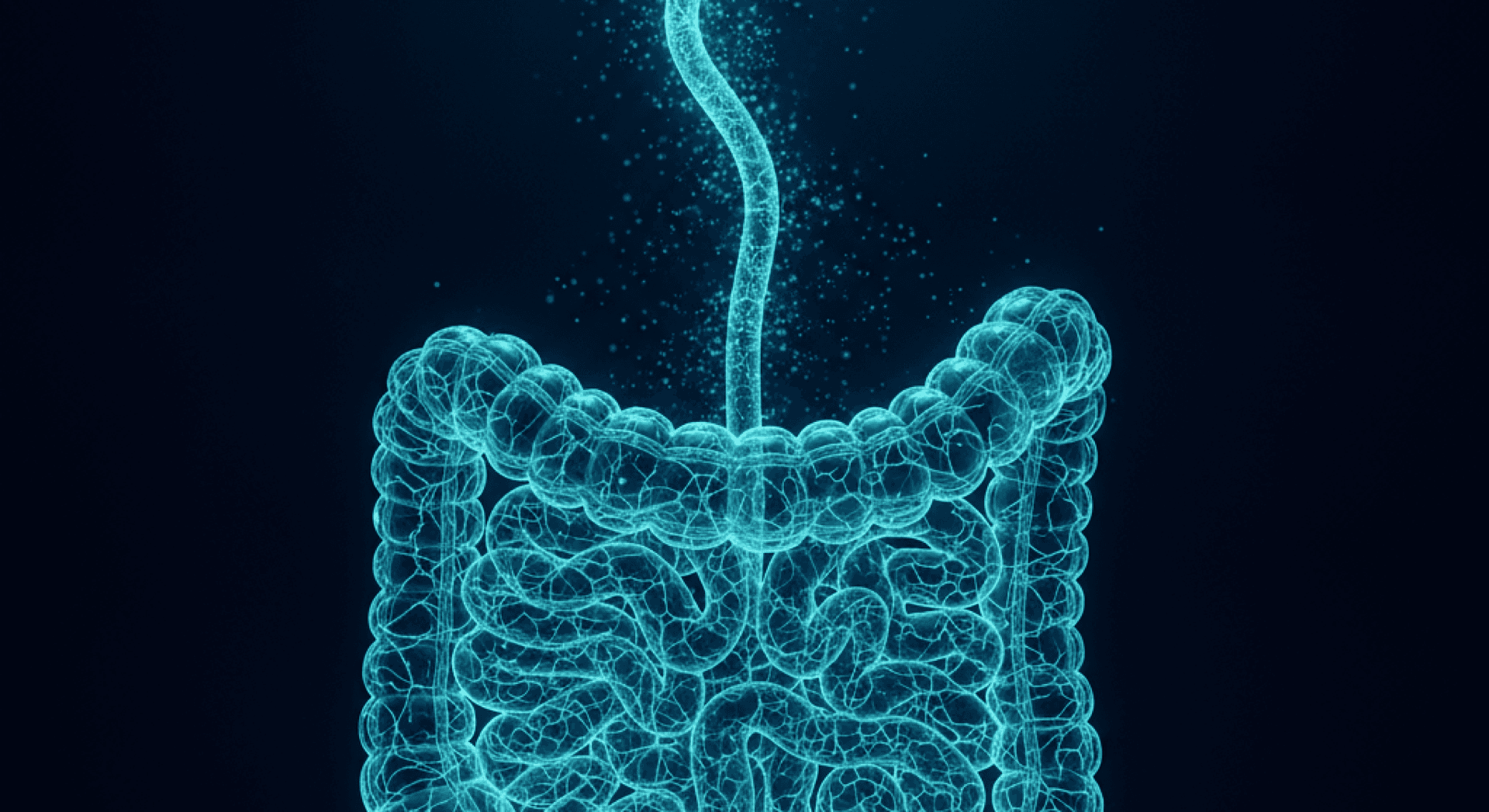
The rationale for IBS is arguably more direct than for any other gut condition. As Bonaz, Bazin and Pellissier (2018) describe, the vagus nerve sits at the interface of the microbiota-gut-brain axis, carrying sensory information from the gut to the brain and motor and regulatory signals back again. It influences gut motility (how the bowel moves), visceral sensation (how gut signals are perceived as pain), and the local inflammatory and microbial environment.
IBS involves disturbances across exactly these domains — altered motility, heightened pain sensitivity, and dysregulated gut-brain signalling, often alongside stress and anxiety. If vagal signalling shapes all of these, then modulating it with stimulation is a coherent therapeutic idea. The broader gut-brain story is covered in our article on VNS and gut health.
What the Trials Show
Two randomised, sham-controlled studies provide the core evidence, and both focused on constipation-predominant IBS (IBS-C).
Shi et al. (2021), in JCI Insight, randomised 42 patients with IBS-C to active taVNS or sham over four weeks. Active stimulation produced substantial improvements over sham: it roughly tripled the number of complete spontaneous bowel movements per week (P = 0.001) and significantly reduced abdominal pain scores (P = 0.001), alongside a mechanistic sub-analysis suggesting improved autonomic (vagal) function.
Liu et al. (2025), in the American Journal of Gastroenterology, reported a single-centre, single-blind randomised trial in 40 patients with IBS-C. Compared with sham, taVNS significantly improved abdominal pain (visual analogue scale, P < 0.001), the frequency of spontaneous bowel movements (P < 0.001), and overall symptom severity on the IBS Severity Scoring System (P < 0.001), with additional improvements in anxiety and depression scores.
Two independent trials pointing the same way is a stronger position than a single study — and the consistency is encouraging. But the qualifiers matter:
Both trials were small (around 40 participants), conducted at single centres, and limited to the constipation-predominant subtype. The Liu trial was single-blind rather than double-blind. These are promising early results, not the large, double-blind, multi-centre evidence that would establish taVNS as a standard IBS treatment.
A Focus on Constipation-Predominant IBS
The most important scope limitation is the IBS subtype. IBS is not one condition: it includes constipation-predominant (IBS-C), diarrhoea-predominant (IBS-D), and mixed forms, which differ in their underlying physiology. The controlled taVNS evidence to date sits almost entirely in IBS-C.
That focus may not be accidental — vagal stimulation can influence gut motility in ways that plausibly help constipation — but it means the benefits seen cannot simply be assumed to transfer to IBS-D or mixed IBS. Those subtypes remain largely untested in randomised trials of vagus nerve stimulation, and it would be misleading to present taVNS as a general "IBS treatment" on the strength of IBS-C data alone.
How Strong Is the Evidence?
Taken together, the picture is one of consistent, biologically plausible, but preliminary positive evidence. Two small sham-controlled trials in IBS-C both favoured active taVNS across pain, bowel frequency, and symptom severity, with supportive mechanistic findings on autonomic function. Against the more equivocal or negative results seen in some other emerging applications, this is a relatively favourable signal.
What is missing is scale and rigour: larger samples, double-blind designs, multiple centres, longer follow-up, and testing across IBS subtypes. Until those exist, the appropriate confidence level is "promising and worth pursuing", not "proven". Reflecting that early state, major clinical guidelines for IBS do not currently list vagus nerve stimulation among recommended treatments.
A Note on How the Stimulation Might Work
Part of what makes the IBS-C findings plausible is that they come with a mechanistic story rather than a bare statistical result. In both trials, the improvements in pain and bowel frequency were accompanied by signs of enhanced vagal (parasympathetic) activity, consistent with the idea that the stimulation was acting through the autonomic pathways it was designed to engage. Vagal signalling influences gut motility, the sensitivity of the gut to painful stimuli, and the low-grade inflammation seen in some IBS patients — so a single intervention plausibly touching several of these at once fits the multi-system picture of the disorder. That said, a plausible mechanism is a supporting argument, not proof of benefit, and the autonomic readouts in small trials should be treated as supportive detail rather than confirmation.
What Has Not Been Tested
The encouraging IBS-C findings should be read alongside a clear list of what the trials did not address. Most obviously, the diarrhoea-predominant (IBS-D) and mixed subtypes are largely absent from the controlled evidence, despite being just as common and just as burdensome. The physiology differs — stimulation that helps a sluggish bowel will not necessarily help an overactive one — so the IBS-C results cannot simply be extended to IBS in general.
Beyond subtype, several design questions remain open. Both trials were short, measuring outcomes over weeks rather than the months or years across which IBS naturally fluctuates, so nothing is known about durability or relapse once stimulation stops. Both were single-centre, raising the question of whether the results would replicate elsewhere. The larger was single-blind rather than double-blind, leaving room for expectation effects. And neither was designed to identify who responds best, or to compare taVNS against established IBS treatments such as dietary therapy, antispasmodics, or gut-directed psychological approaches.
The Placebo Problem in IBS
There is a particular reason to insist on rigorous controls in irritable bowel syndrome: few conditions respond as strongly to placebo. IBS symptoms are subjective, fluctuate with stress and circumstance, and improve substantially in the control arms of many trials — sometimes nearly as much as in the active arms. Any intervention studied in IBS therefore starts with a high bar to clear, because a large share of the apparent benefit in an uncontrolled or weakly blinded study will reflect the placebo response rather than the treatment itself.
This is exactly why the design details of the taVNS trials matter so much. A sham-controlled study, in which the comparison group receives an inactive but convincing version of the stimulation, is the only way to separate a real effect from the strong placebo backdrop. The Shi trial used such a sham comparison, which counts in its favour; the larger Liu trial was single-blind, which leaves more room for expectation to inflate the result.
It also explains why two small positive trials, encouraging as they are, do not yet amount to proof. In a condition where placebo responses are this powerful, the evidence has to be correspondingly strong — larger, double-blind, and replicated — before a treatment can be considered established. The taVNS signal in IBS-C is real enough to pursue; it is not yet strong enough to rely on.
Safety
taVNS is non-invasive and generally well tolerated, with side effects that are usually limited to mild local tingling or discomfort at the ear — as discussed in our review of the safety profile of VNS. Both IBS trials reported it was acceptable to participants. Its favourable safety profile is part of what makes it an attractive option to keep studying, but, as always, being safe is not the same as being effective.
The Bottom Line
For constipation-predominant IBS, ear-based vagus nerve stimulation has a modestly encouraging evidence base — more positive than several other emerging applications, but still early:
- The gut-brain rationale is strong and well characterised (Bonaz et al., 2018).
- Two small randomised, sham-controlled trials in IBS-C reported benefits in pain, bowel frequency, and symptom severity (Shi et al., 2021; Liu et al., 2025).
- The evidence is limited to small, single-centre studies in one IBS subtype, and lacks large double-blind confirmation.
If you have IBS and are considering taVNS, the reasonable stance is cautious optimism: there is real signal here, particularly for the constipation-predominant subtype, but it is not yet a proven treatment. Discuss it with your clinician, and be wary of marketing that presents it as an established cure for IBS in general. For a related gut application, see our article on VNS for inflammatory bowel disease, and browse the studies in our Evidence Database.
---
References
Bonaz, B., Bazin, T. & Pellissier, S. (2018). The vagus nerve at the interface of the microbiota-gut-brain axis. Frontiers in Neuroscience, 12, 49.
Liu, J. et al. (2025). Efficacy and safety of transcutaneous auricular vagus nerve stimulation in patients with constipation-predominant irritable bowel syndrome: a single-center, single-blind, randomized controlled trial. American Journal of Gastroenterology, 120(9), 2139–2153.
Shi, X. et al. (2021). Ameliorating effects and mechanisms of transcutaneous auricular vagal nerve stimulation on abdominal pain and constipation. JCI Insight, 6(14), e150052.