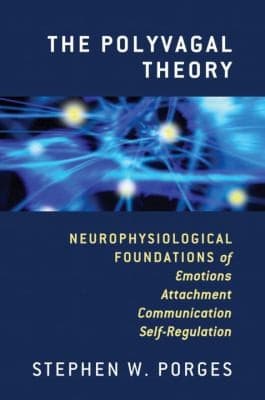
Foundational theory
The Polyvagal Theory
Neurophysiological Foundations of Emotions, Attachment, Communication, and Self-Regulation
Stephen W. Porges
2011 · W. W. Norton
Our review
This is the most influential and the most contested book on the shelf, and both facts deserve equal billing. Nearly every popular title about vagal tone, nervous-system regulation, and "safety states" traces back to Stephen Porges' work — so to understand the field, you eventually have to read the source rather than the summaries.
Porges' proposal is that the mammalian autonomic nervous system is organised as a hierarchy tied to the vagus nerve's structure: an evolutionarily older branch driving immobilisation and shutdown, a newer myelinated branch supporting calm social engagement, and the sympathetic system for mobilisation in between. Layered on this is neuroception — the idea that the body continuously, unconsciously scans for cues of safety or danger and shifts state accordingly. It's an ambitious synthesis of evolution, neurophysiology, and clinical observation, and it gave clinicians a vocabulary that has genuinely reshaped trauma therapy.
Here is the part most reviews omit. The theory is the subject of a serious, ongoing scientific dispute. Critics — notably Paul Grossman, E.W. Taylor, and anatomists such as Neuhuber and Berthoud — argue that its evolutionary and neuroanatomical claims, and its use of respiratory sinus arrhythmia as a vagal-tone measure, do not hold up against established physiology; a 2026 multi-author critique went as far as calling it "untenable." Porges responds that critics attack a "reconstructed proxy" rather than the theory as written, and that it yields testable, falsifiable predictions. The honest reader's position: this is a live debate, not a settled science.
On this shelf: the theoretical root. Dana and Rosenberg are its practical descendants; read this to see the contested engine that drives them, and read it critically.
Best for: readers who want the foundation in the author's own words — and who want to understand what is genuinely established versus still argued over.
Explore the evidence