Popular science — flagship
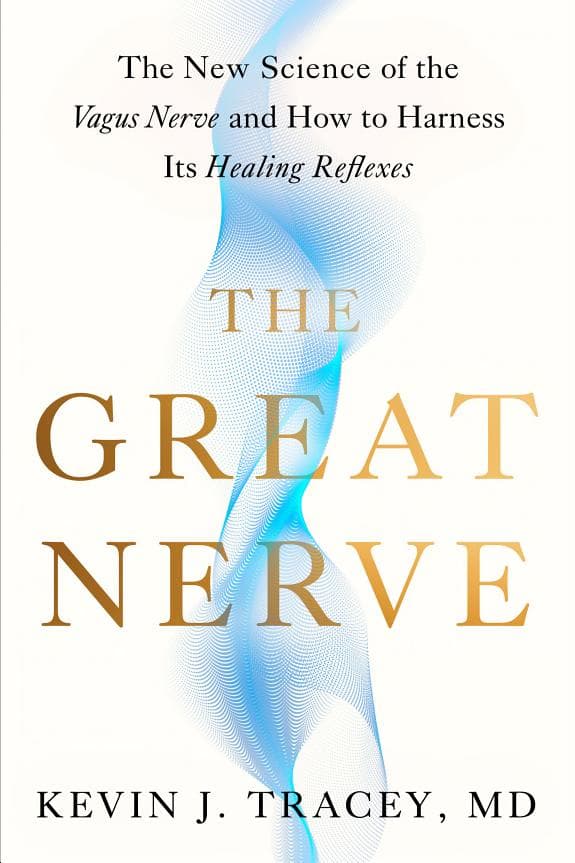
The Great Nerve
The New Science of the Vagus Nerve and How to Harness Its Healing Reflexes
Kevin J. Tracey, MD
2025 · Penguin Life
Our review
Most books about the vagus nerve are written about the science. This one is written by it. Kevin Tracey is the neurosurgeon whose lab found the discovery the whole field now orbits — and that changes what kind of book this is. Not reportage, but the origin story told by the person at the origin.
Its central idea is deceptively precise. In 2000, Tracey's team showed the vagus nerve doesn't merely calm the heart and gut — it governs the immune system through what they named the inflammatory reflex: vagal signals prompt acetylcholine to act on immune cells in the spleen, switching off inflammatory molecules like TNF. That one mechanism is the hinge on which "bioelectronic medicine" turns — the premise that a nerve implant could do a biologic drug's job by instructing the body to stop inflaming itself. The book follows that idea from a chance lab observation to FDA Breakthrough-designated trials in rheumatoid arthritis.
What keeps it credible rather than evangelical is where Tracey draws his lines. The vagus nerve is now a wellness buzzword, and he could have ridden the wave. Instead he adjudicates it — weighing ice baths, breathwork, meditation, and exercise as claims to be tested, not products to be sold. For anyone trying to separate mechanism from marketing, that restraint is the book's real gift.
The fair caveat: Tracey holds patents and co-founded companies in this space, so the arc bends toward promise and the patient stories are chosen to inspire. Read it for the why and the trajectory — not as a sober ledger of what's proven today.
On this shelf: the ceiling for scientific authority among the popular titles. Porges gives you the rival theoretical frame; Habib and Rosenberg give you the protocols; the clinical references supply the caveats Tracey soft-pedals. Start here, then triangulate.
Best for: the reader who wants the field's foundation from the person who laid it — before turning to the primary evidence to pressure-test the optimism.
Explore the evidence