Practical self-help — polyvagal (classic)
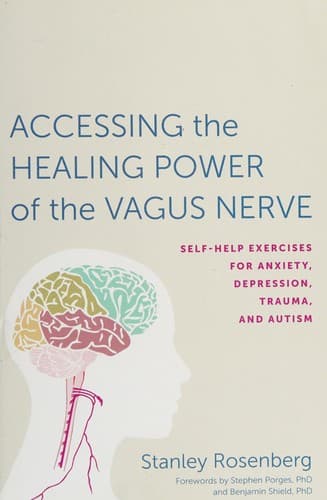
Accessing the Healing Power of the Vagus Nerve
Self-Help Exercises for Anxiety, Depression, Trauma, and Autism
Stanley Rosenberg
2017 · North Atlantic Books
Our review
Stanley Rosenberg writes as a bodyworker, not a neuroscientist, and that's precisely what makes this book distinctive: it is the most physical, hands-on title in the category. Where others explain the vagus nerve, Rosenberg has you touch, move, and test it. A foreword from Stephen Porges signals the lineage — this is polyvagal theory translated into the language of the manual therapist.
The practical heart of the book is a small set of simple exercises — subtle eye, neck, and breathing manoeuvres — aimed at shifting the nervous system toward Porges' "ventral vagal" state of safety and social engagement. Rosenberg frames these through the cranial nerves and reports using them for anxiety, trauma, and a range of dysregulation. The instructions are clear enough to follow at home, which is a large part of why the book has endured and why it's so widely recommended by hands-on practitioners.
Two honest caveats. First, the theoretical scaffolding is polyvagal theory, whose anatomical and evolutionary claims are genuinely contested in the scientific literature (see the Porges analysis). Second, the evidence here is largely clinical observation from one experienced practitioner rather than controlled trials — the exercises are low-risk and many report benefit, but "it worked in my practice" is a different order of proof than a randomised study. Approached as gentle, plausible self-regulation tools, they're a reasonable thing to try.
On this shelf: the practical, body-based arm of the Porges lineage. Read Porges for the theory, Dana for the felt/emotional framing, and Rosenberg when you want something to actually do with your hands.
Best for: the reader who learns by doing and wants concrete, physical exercises today — while holding the underlying theory as contested rather than proven.
Explore the evidence